Dizziness and vertigo can come from a problem in your vestibular system, the balance organ in your inner ear. A common cause is benign paroxysmal positional vertigo (BPPV), which a physiotherapist can assess and often treat with simple head movements.
What is the vestibular system?
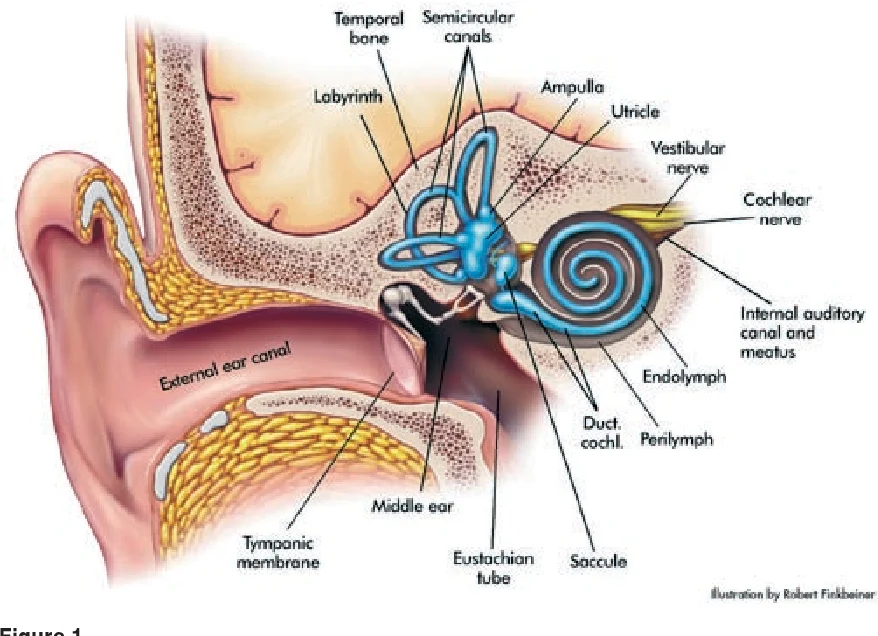
The vestibular system is located in your inner ear. It creates your sense of balance and helps you to understand your orientation in space. The vestibular system contributes to perception and balance by monitoring the position and motion of the head. It achieves this action by reacting to information provided by small receptors within the inner ear.
How does it work?
The vestibular system is made up of three semicircular canals and two otolith organs. The three semicircular canals are called the posterior, anterior and lateral canals. The posterior semicircular canal detects head tilting, the superior semicircular canal detects up and down movement of the head and the lateral semicircular canal detects side to side movement of the head.
In the three semicircular canals, there is a fluid called endolymph. When the head is moved, the endolymph is displaced in the opposite direction within the canals and the receptors process this information and then it is sent to the central nervous system where it is processed, and spatial awareness is then perceived.
The otolith organs, which resemble sacs, contain calcium carbonate crystals called the otoconia. When these crystals move within the sacs the receptors process this information and it is relayed to the central nervous system. The otolith organs detect the position and linear acceleration of the head. An example of linear acceleration would be keeping the head still in an elevator that is moving up and down. During this action, there is no active movement of the head but the position of the head in space alters as the elevator moves up and down.
What is benign paroxysmal positional vertigo (BPPV)?
BPPV is one of the most common causes of vertigo in adults. It is a mechanical problem where the otoconia (calcium carbonate crystals) become dislodged from the utricle and saccule and make their way into the semicircular canals. If you experience BPPV, some symptoms that may develop include brief episodes of vertigo, particularly with changes in head position, a feeling of imbalance as well as nausea. Some common triggers are: transitioning from lying flat to sitting or vice versa, rolling over when lying flat, bending over or looking up.
What can I do if I have these symptoms?
Physiotherapists are trained to evaluate whether your vestibular system is the cause of your vertigo. If you are feeling dizzy you should have an assessment to determine the cause. If you do have BPPV, there are special treatments (repositioning manoeuvres) that can help move the otoconia back to the otolith organs. We are also trained in treatment techniques for other types of vertigo. Read more about vertigo and BPPV treatment at Physionorth.
See your GP or call 000 straight away if your dizziness comes with a severe headache, chest pain, trouble speaking, weakness or numbness, double vision or fainting.
*All information is general in nature. Patients should consider their personal circumstances and seek a second opinion.