The thumbs-up movement relies on a forearm muscle called abductor pollicis longus, which moves your thumb out to the side. Its tendon is involved in common thumb and wrist problems such as de Quervain’s tenosynovitis and Bennett fractures, and most cases of de Quervain’s improve with non-surgical care such as physiotherapy and splinting.
OK, everyone knows how to give a thumbs up, but do you really know how to give a thumbs up? To do this we need to focus on the Abductor Pollicis Longus, a muscle of the forearm. This muscle gives us some insight into common thumb and wrist injuries.
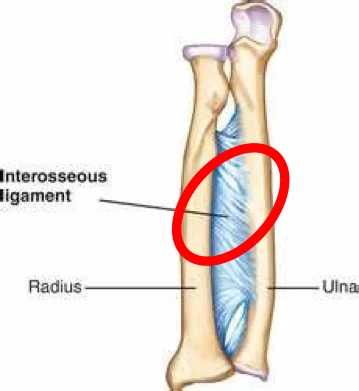
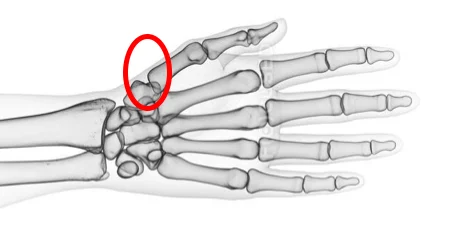
The Abductor Pollicis Longus originates from the body of the ulna, interosseous ligament, and the middle third portion of the radius. The muscle belly ends into a long tendon, which inserts into the radial side base of the first metacarpal bone. This is a bone at the base of the thumb. The nerve that supplies this muscle is the posterior interosseous nerve, a deep branch of the radial nerve.
Why is this muscle important?
It’s because it abducts (moves away from the hand) and helps extend the thumb. That is, it helps you give a thumbs up!

De Quervain’s tenosynovitis
However, this muscle is involved in a few common thumb and wrist injuries, such as de Quervain’s tenosynovitis, whereby the tendons of the Abductor Pollicis Longus and the Extensor Pollicis Brevis may become irritated and gliding becomes impaired. Symptoms are often characterised by pain, tenderness and swelling of the thumb side of the wrist.
De Quervain’s tenosynovitis is often classified as a repetitive strain injury (RSI); however, there are complex interactions between genetic factors and biopsychosocial factors that can contribute to the painful symptoms (Peters‐Veluthamaningal, van der Windt, Winters, & Meyboom‐de Jong, 2009).
Treatment of de Quervain’s tenosynovitis may be operative or non-operative, with most patients improving with conservative treatment involving physiotherapy (stretching and strengthening), splinting and corticosteroid injections (Ilyas, 2009; Ippolito, Hauser, Patel, Vosbikian, & Ahmed, 2018).
Bennett fracture
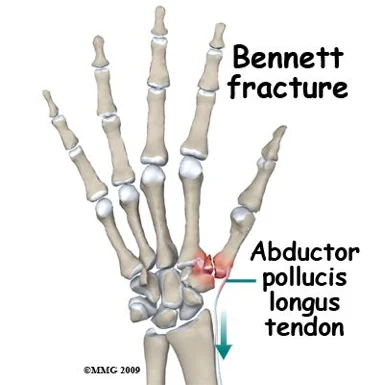
The Abductor Pollicis Longus can be affected by traumatic injuries such as the Bennett fracture, usually sustained by a fall on an extended thumb, or upon hard impact of a closed fist (Brownlie & Anderson, 2011). This is predominantly due to where the Abductor Pollicis Longus attaches in the hand (base of first metacarpal bone).
Due to the complexity of the injury, Bennett fractures are usually managed by hand surgeons, and a physiotherapist often helps with rehabilitation afterwards. If you have ongoing thumb or wrist pain, our physiotherapists can assess it and guide your rehabilitation.
References
Brownlie, C., & Anderson, D. (2011). Bennett fracture dislocation Review and management. Australian Family Physician, 40, 394-396.
Ilyas, A. M. (2009). Nonsurgical Treatment for de Quervain’s Tenosynovitis. Journal of Hand Surgery, 34(5), 928-929. doi:10.1016/j.jhsa.2008.12.030
Ippolito, J. A., Hauser, S., Patel, J., Vosbikian, M., & Ahmed, I. (2018). Nonsurgical Treatment of De Quervain Tenosynovitis: A Prospective Randomized Trial. Hand (New York, N.Y.), 1558944718791187-1558944718791187. doi:10.1177/1558944718791187
Peters‐Veluthamaningal, C., van der Windt, D., Winters, J. C., & Meyboom‐de Jong, B. (2009). Corticosteroid injection for de Quervain’s tenosynovitis. Cochrane Database of Systematic Reviews(3). doi:10.1002/14651858.CD005616.pub2