
Shoulder pain

Sore when you reach overhead, lift or lie on that side? Most shoulder pain responds well to the right exercise plan, and you don't need a referral to get started.
About shoulder pain

Shoulder pain is usually felt at the front or side of the shoulder, and sometimes down the upper arm. It often makes reaching overhead, doing up a bra or tucking in a shirt, and sleeping on that side hard. Most of the time it comes from the muscles and tendons around the joint, not serious damage.

The most common cause is rotator cuff pain, often called impingement or bursitis. It tends to follow a jump in lifting, painting, swimming or gym work. Rotator cuff tears can happen with a fall, or slowly with age. A dislocation, where the ball comes out of the socket after a fall or tackle, can leave the shoulder feeling loose or unstable.

Frozen shoulder is different: the joint becomes painful, then very stiff, over months. Healthdirect notes it is more common in people over 40, women and people with diabetes, and can take one to three years to settle without treatment.

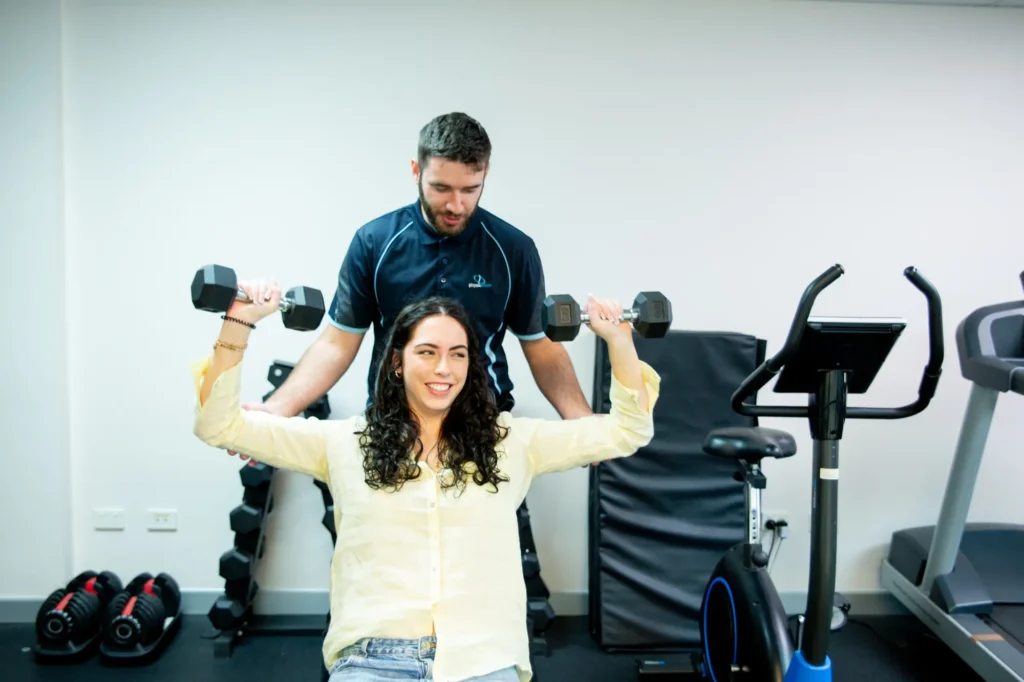
A physiotherapist supervising an overhead dumbbell exercise
Gentle movement stops a sore shoulder stiffening.

Keep it moving, within comfort

Resting a sore shoulder in a sling for weeks usually makes it stiffer. Keep using your arm for light tasks below shoulder height, and ease off anything that causes sharp pain or pain that lingers into the night. Sleeping on the other side, hugging a pillow to support the sore arm, often helps.

If you lift weights or swim, cut the load back rather than stopping completely, then build up again over a few weeks.

How we treat it

Your physiotherapist will ask how the pain started and what sets it off. We watch how your arm and shoulder blade move together, test the strength of your rotator cuff, and check your neck and upper back, which often play a part.

Treatment may include:

  • a graded strengthening program for the rotator cuff and shoulder blade muscles, the main treatment for most shoulder pain
  • hands-on treatment to ease stiff joints and tight muscles
  • advice on sleeping positions, desk set-up, and how to adjust gym, swim or work loads while it settles
  • a staged plan to regain movement in frozen shoulder, matched to how irritable it is
  • rehabilitation after a dislocation or shoulder surgery, following your surgeon's guidelines
  • dry needling or taping, if they suit you

As you get stronger, our small Strength & Mobility classes are a supervised way to keep building. If a scan or injection might help, we will talk it through with your GP.

Read more on our blog: Shoulder impingement: what does it mean? and 6 things you need to know about tendinopathy.

See a doctor straight away if

your shoulder looks out of shape or you can't move your arm after a fall or tackle, your arm or hand is numb, cold or pale, or you suddenly can't lift your arm after an injury. Call 000 if shoulder or arm pain comes with chest pain, shortness of breath, sweating or nausea. Also see a doctor if the shoulder is hot, red and swollen and you feel unwell with a fever, or you have night pain that no position eases along with unexplained weight loss.

Getting started

Who you'll see

One of our physiotherapists, one to one in a private room. You can choose your physiotherapist when you book. Meet the team.

Your first appointment

60 minutes. We listen to your story, check how you move, explain what we find and start treatment, then give you a short plan to follow at home. Follow-up appointments are 30 minutes.

Cost and rebates

First appointment $225. Follow-up $150, or $135 on a pass. No referral needed. We claim private health rebates on the spot with Tyro (works like HICAPS) where available. We are not a bulk billing clinic: with a GP care plan (GPCCMP), you pay in full and Medicare pays $63.40 back for up to five allied health visits a year. If you can't make an appointment, please give us 24 hours notice. Funding and referrals.

Where and when

Suite 2, 69 Eyre Street, North Ward, Townsville. Free parking on both sides of Eyre Street, plus an accessible bay right outside. Open Monday to Thursday 7 am to 7 pm, Friday 7 am to 3:30 pm and Saturday 7 am to 1:30 pm. Book online or call 07 4724 0768.

Common questions

Do I need a scan?

Usually not at first. Many people over 40 have rotator cuff changes on a scan with no pain at all, so a scan does not always explain your symptoms. Your physio will suggest asking your GP for one if you have had a significant injury, have marked weakness, or are not improving.

How long does it take to get better?

It depends on the cause. Tendon pain often takes several weeks to a few months of regular exercise to settle, while frozen shoulder can take much longer. Your physio will give you a realistic idea after your first appointment.

Is a cortisone injection a good idea?

It can ease pain in the short term for some people, but it does not strengthen the shoulder. Talk it over with your GP, and read our blog on the pros and cons of cortisone injections.

Do I need a referral?

No. Private patients can book straight in. If you have a GP care plan from your GP, bring it so you can claim the Medicare rebate.