
Knee pain
Knee sore on stairs, when you squat, or after a twist at sport? Most knee pain can be helped with the right exercise and load plan, and you don't need a referral to start.
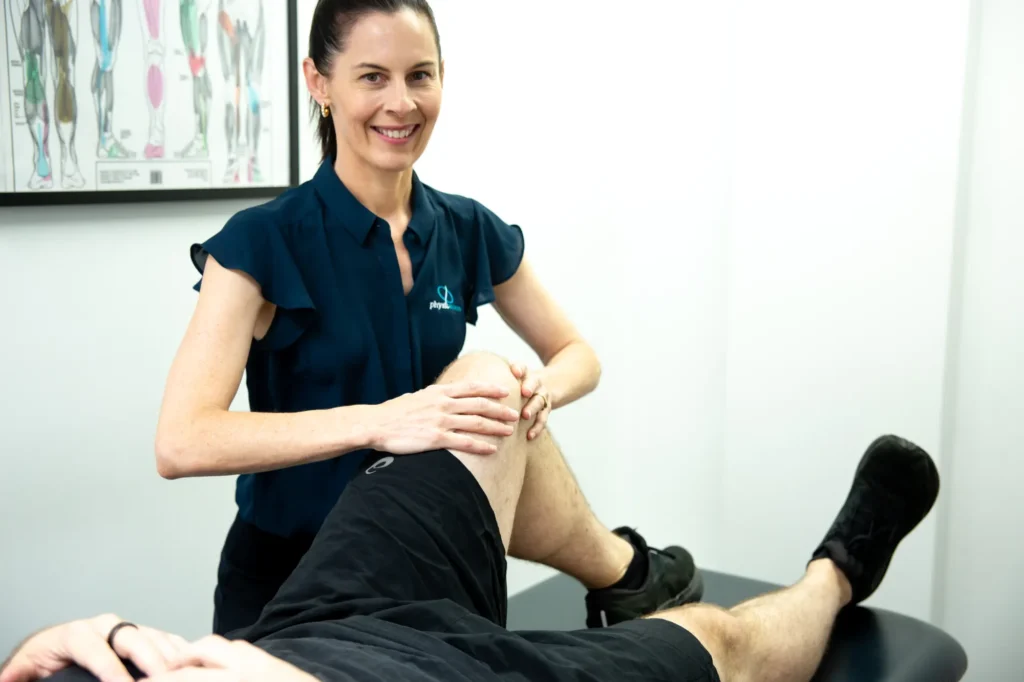
About knee pain
Where your knee hurts gives clues to the cause. It may start suddenly with a twist, landing or knock, or build up slowly with more walking, running, stairs or kneeling.
Pain around or behind the kneecap (patellofemoral pain) is one of the most common types, especially in runners, teenagers and people who squat or climb a lot. Ligament injuries, such as an ACL or MCL sprain, usually follow a twist or tackle and may come with a pop, fast swelling or the knee giving way. A meniscus tear can cause catching, locking or swelling, and in people over 40 it can come on with little or no injury. In active, growing kids, pain below the kneecap is often Osgood-Schlatter disease.
If you are over 45 and your knee aches with use and is stiff for a short time in the morning, osteoarthritis may be part of the picture. Our knee, hip and osteoarthritis page explains how exercise and physio can help.

Load it, don't rest it completely
Knees like movement. Keep walking on flat ground, and cycling or swimming if they feel comfortable, and cut back for now on what flares the pain, such as deep squats, kneeling, hills or long runs. A little discomfort during exercise is usually fine if it settles by the next morning.
After a fresh twist, protect the knee for a few days, keep it raised and use a compression bandage, then start gently loading it again as comfort allows. This is the PEACE & LOVE approach that has replaced RICE.
How we treat it
We ask how the pain started, then watch how your hips, knees and feet line up when you walk, squat and step down. Weak hip or thigh muscles, stiff ankles or a sudden jump in training often add load to the knee. After an injury we also test your ligaments and meniscus.
Treatment may include:
- strengthening for your thigh, hip and calf muscles, progressed as you improve
- hands-on treatment and taping to ease pain while you build strength
- a plan to adjust running, stairs, kneeling or gym work so the knee can settle
- balance, landing and agility training to prepare you for sport
- ACL rehabilitation, with or without surgery, and rehabilitation after knee surgery
Our sports physiotherapy team can plan your return to sport, and our small Let's Get Functional and Strength & Mobility classes are a good next step.
Read more on our blog: Knee pain, ACL injury management: surgery vs physiotherapy and Osgood-Schlatter disease.
you can't put weight on your leg after an injury, your knee is locked and won't straighten, it looks out of shape, or it is hot, red and swollen and you feel unwell or have a fever. Also see a doctor urgently if you have a painful, swollen calf, especially after surgery or a long trip, as this can be a sign of a blood clot.
Getting started
Who you'll see
One of our physiotherapists, one to one in a private room. You can choose your physiotherapist when you book. Meet the team.
Your first appointment
60 minutes. We listen to your story, check how you move, explain what we find and start treatment, then give you a short plan to follow at home. Follow-up appointments are 30 minutes.
Cost and rebates
First appointment $225. Follow-up $150, or $135 on a pass. No referral needed. We claim private health rebates on the spot with Tyro (works like HICAPS) where available. We are not a bulk billing clinic: with a GP care plan (GPCCMP), you pay in full and Medicare pays $63.40 back for up to five allied health visits a year. If you can't make an appointment, please give us 24 hours notice. Funding and referrals.
Where and when
Suite 2, 69 Eyre Street, North Ward, Townsville. Free parking on both sides of Eyre Street, plus an accessible bay right outside. Open Monday to Thursday 7 am to 7 pm, Friday 7 am to 3:30 pm and Saturday 7 am to 1:30 pm. Book online or call 07 4724 0768.
Common questions
Do I need an X-ray or MRI?
Not always. After an injury, an X-ray is usually only needed if a broken bone is possible, for example if you can't walk four steps, can't bend your knee to a right angle, or the kneecap or bony bumps are very tender. An MRI may help if a ligament or meniscus tear could change your treatment.
How do I know if I've torn my ACL?
Common signs are a pop at the time of injury, swelling within a few hours, and the knee feeling unstable or giving way when you turn. Your physio can test the ligament.
Will I need surgery for a meniscus tear?
Not always. For tears that come on with age rather than a big injury, exercise-based physio is usually tried first. Surgery is more likely to be considered if your knee keeps locking or after a large tear from an injury.
Do I need a referral?
No. Private patients can book straight in. With a GP care plan from your GP, you can claim a Medicare rebate for up to five allied health visits a year.