
Running injuries

Shins, knees or Achilles complaining as your kilometres go up? Most running injuries come from load that has built up faster than your body has adapted, and the right changes can help you keep running.
About running injuries

Most running injuries are overuse injuries: tissue is loaded more than it can recover from between runs. Common triggers are a sudden jump in distance, speed work or hills, new shoes, a race build-up, or coming back after a break. Weakness in the calves and hips, poor sleep and not eating enough can add to the problem.

Common problems we see include:

  • shin pain (shin splints), an ache along the inside edge of the shin
  • runner's knee, pain around the kneecap that is worse on hills, stairs or squatting
  • ITB pain, a sharp pain on the outside of the knee, often on longer or downhill runs
  • Achilles tendon pain, stiff in the morning and sore at the back of the heel
  • plantar fasciitis and hamstring tendon pain

Bone can be overloaded too, causing a stress reaction or stress fracture. Warning signs are pain in one spot on a bone, pain that starts earlier in each run, pain when you hop, and pain at rest or at night. Rapid training increases, low energy intake and, in women, missed periods raise the risk. If you notice these, stop running and get checked.

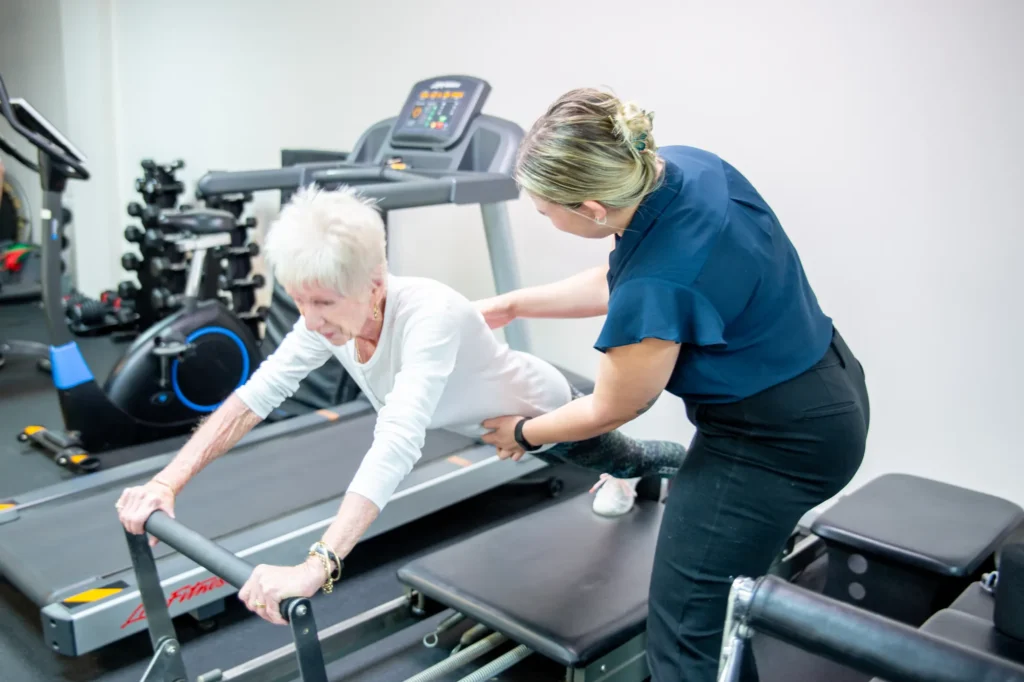
Exercise physiology on the treadmill with an older patient
Small training changes often ease running pain.

Change the load, not just the shoes

Most running pain settles when you adjust your training rather than stop altogether. Cut back distance or speed, choose flatter routes, and swap a session for cycling or swimming. As a guide, if pain stays mild during a run, settles within 24 hours and isn't worse the next morning, running is often okay.

Build back up gradually and keep most of your running at an easy pace. Our blog on running intensity explains why.

How we treat it

We look at your training history, recent changes, shoes and goals, then assess your strength, flexibility and single-leg control.

Treatment may include:

  • strength training for your calves, hips and thighs, to help your body handle running load
  • a load management plan for weekly distance, speed and hills
  • hands-on treatment, dry needling or taping for short-term relief
  • a staged return-to-run program after injury

Our sports physiotherapy and exercise physiology teams work with runners of all levels, from your first 5 km to long trail races.

Read more on our blog: Running intensity: how much is too much?, 5 simple exercises to improve your trail running and Proximal hamstring tendinopathy.

See a doctor straight away if

you have chest pain, fainting, severe breathlessness or a racing heart while running (call 000), or a hot, swollen, painful calf. Stop running and get checked promptly if you have pain in one spot on a bone that hurts to press or hop on, or bone pain at rest or at night, as these can be signs of a stress fracture.

Getting started

Who you'll see

One of our physiotherapists, one to one in a private room. You can choose your physiotherapist when you book. Meet the team.

Your first appointment

60 minutes. We listen to your story, check how you move, explain what we find and start treatment, then give you a short plan to follow at home. Follow-up appointments are 30 minutes.

Cost and rebates

First appointment $225. Follow-up $150, or $135 on a pass. No referral needed. We claim private health rebates on the spot with Tyro (works like HICAPS) where available. We are not a bulk billing clinic: with a GP care plan (GPCCMP), you pay in full and Medicare pays $63.40 back for up to five allied health visits a year. If you can't make an appointment, please give us 24 hours notice. Funding and referrals.

Where and when

Suite 2, 69 Eyre Street, North Ward, Townsville. Free parking on both sides of Eyre Street, plus an accessible bay right outside. Open Monday to Thursday 7 am to 7 pm, Friday 7 am to 3:30 pm and Saturday 7 am to 1:30 pm. Book online or call 07 4724 0768.

Common questions

Do I have to stop running?

Often not. Many running injuries can be managed by changing how much, how fast or where you run. Bone stress injuries are the exception and usually need a break from running.

Do I need new shoes or orthotics?

Sometimes, but shoes are rarely the whole story. Choose a shoe that feels comfortable, and change models gradually. Your physio will tell you if an insert is worth trying.

How fast can I increase my kilometres?

There is no single safe number. Increase one thing at a time, such as distance, speed or hills, include easier weeks, and watch how your body responds over the next 24 hours.

Do I need a referral?

No. You can book straight in, and we claim private health rebates on the spot where available.