
Ankle sprains and instability

Rolled your ankle at sport, on a trail or stepping off a kerb? Early movement and the right exercises help most sprains recover, and we can tell you if you need an X-ray.
About ankle sprains

An ankle sprain is a stretch or tear of the ligaments that hold the ankle bones together. Most happen when the foot rolls inwards, hurting the ligaments on the outside of the ankle. You may have pain, swelling, bruising and trouble walking, and you might have heard or felt a pop.

Sprains range from mild to severe. A high ankle sprain, which affects the ligament joining the two lower leg bones, often follows a twisting or tackling injury and usually takes longer to recover than a typical rolled ankle.

Many people roll the same ankle again, often because their balance, strength and ankle control never fully came back after the first sprain. If your ankle keeps giving way, feels wobbly on uneven ground or swells after sport, you may have chronic ankle instability. Targeted balance and strength training is the main treatment.

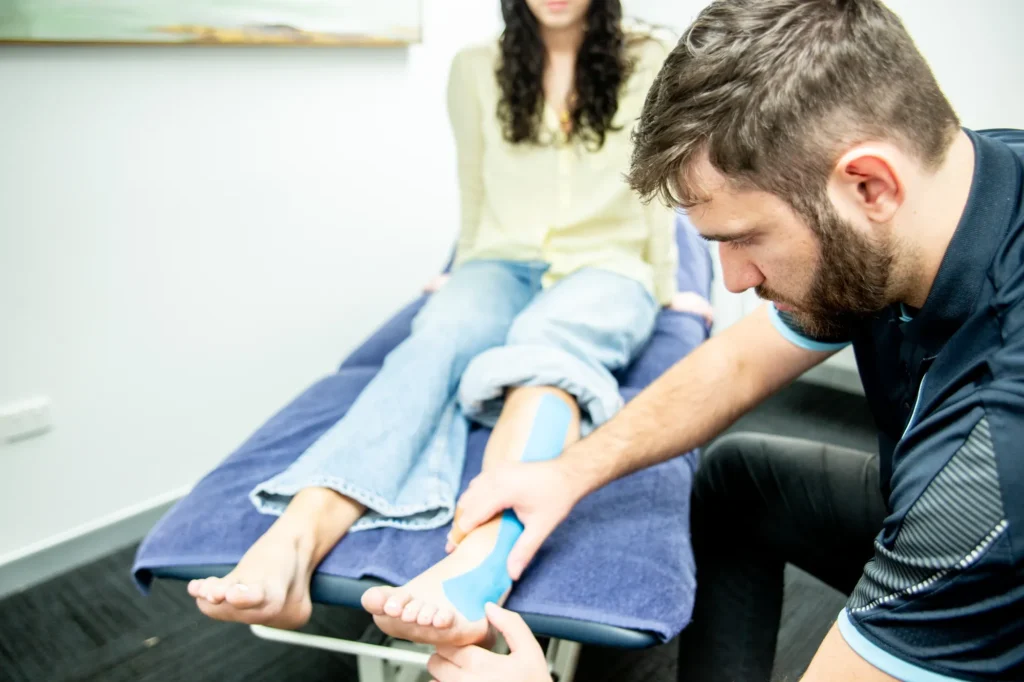
A physiotherapist taping a patient’s ankle
Early, gentle loading helps a sprained ankle recover.

PEACE & LOVE, not just ice

For the first few days, think PEACE: Protect the ankle by easing off what hurts, Elevate it above your heart, Avoid anti-inflammatory medicines and long icing early on as they may slow healing, Compress it with a bandage, and Educate yourself on what to expect. Check with your doctor or pharmacist about pain relief.

After that comes LOVE: Load the ankle by walking as comfort allows, stay Optimistic, get your blood flowing (Vascularisation) with gentle cardio such as cycling, and Exercise to bring back movement, strength and balance.

How we treat it

First we check whether you need an X-ray, using the Ottawa ankle rules. Then we test your ligaments and look at swelling, movement, strength and balance on both legs. We ask about past sprains and what you need to get back to, whether that is netball, trail running or walking the Strand.

Treatment may include:

  • early advice on walking, bracing or taping so you can stay active safely
  • hands-on treatment to restore ankle movement
  • calf, hip and peroneal (outer lower leg) strengthening
  • balance and hopping drills to retrain ankle control and lower your risk of rolling it again
  • a staged return-to-sport plan with running, cutting and landing drills

Our sports physiotherapy team can guide your return to sport, and the All About Balance class is a good way to keep working on ankle control.

Read more on our blog: 5 simple exercises to improve your trail running and Commonly missed signs of injury.

See a doctor straight away if

you couldn't take four steps straight after the injury, the ankle looks out of shape, the bony bumps of the ankle or the outer edge of the midfoot are very tender to touch, or your foot is numb, cold or pale. Also see a doctor promptly if you felt a snap at the back of the ankle and can't push up onto your toes, which can be an Achilles rupture, or you develop a painful, swollen calf in the weeks after the injury.

Getting started

Who you'll see

One of our physiotherapists, one to one in a private room. You can choose your physiotherapist when you book. Meet the team.

Your first appointment

60 minutes. We listen to your story, check how you move, explain what we find and start treatment, then give you a short plan to follow at home. Follow-up appointments are 30 minutes.

Cost and rebates

First appointment $225. Follow-up $150, or $135 on a pass. No referral needed. We claim private health rebates on the spot with Tyro (works like HICAPS) where available. We are not a bulk billing clinic: with a GP care plan (GPCCMP), you pay in full and Medicare pays $63.40 back for up to five allied health visits a year. If you can't make an appointment, please give us 24 hours notice. Funding and referrals.

Where and when

Suite 2, 69 Eyre Street, North Ward, Townsville. Free parking on both sides of Eyre Street, plus an accessible bay right outside. Open Monday to Thursday 7 am to 7 pm, Friday 7 am to 3:30 pm and Saturday 7 am to 1:30 pm. Book online or call 07 4724 0768.

Common questions

Do I need an X-ray?

Often not. The Ottawa ankle rules help decide. An X-ray is usually only needed if you couldn't walk four steps straight after the injury and when you are examined, or if there is tenderness on the back edge or tip of either ankle bone, or on certain bones of the midfoot. Your physio can check this for you.

Should I wear a brace or tape?

A brace or tape can support the ankle while it heals and when you first return to sport. It works well alongside balance and strength exercises, not instead of them.

How long does a sprained ankle take to heal?

It varies with how bad the sprain is. Mild sprains often feel much better within a few weeks, but ligaments keep remodelling for months, so getting your strength and balance back matters more than the calendar.

Why does my ankle keep rolling?

After a sprain, the ankle's sense of position and the muscles that protect it can stay weak. Specific balance and strength training can help. If it keeps happening, book an assessment.

Do I need a referral?

No. Private patients can book straight in, and we claim private health rebates on the spot where available.