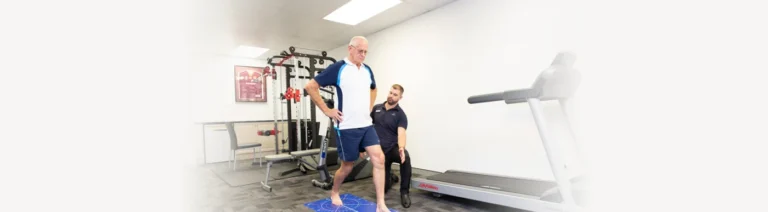
After a stroke, physiotherapy helps you relearn movement, balance and everyday tasks by training your brain to find new pathways around the damaged area (neuroplasticity). Starting rehab early and practising often gives you a better chance of recovery, and progress can continue for months and years after the stroke.
Learning the signs of stroke helps people get help more quickly.
To recognise those signs, the Stroke Foundation encourages you to think FAST when looking at someone who may be experiencing a stroke:
- Face – has their face dropped?
- Arms – can they lift both arms?
- Speech – is their speech slurred? Can they understand you?
- Time – every second counts. Call 000 immediately.
Here, we explore the causes and impact of stroke and explain how physiotherapy can help.
What is a stroke?
A stroke deprives your brain of vital oxygen and nutrients. It’s a leading cause of death and disability in Australia.
Your brain is a highly specialised organ with different sections responsible for different aspects of your body, like your movements, speech, thought processes and behaviour.
Stroke happens when a blocked or burst artery stops oxygen-rich, nutrient-packed blood getting to your brain. Brain cells in the affected area start to die very quickly.
While stroke can affect anyone, the risk is higher if you:
- Are a man
- Are older
- Have high blood pressure or high cholesterol
- Have diabetes
- Smoke
- Drink too much alcohol
- Are overweight
What’s life like after a stroke?
Depending on where and how severely your stroke affects your brain, you may experience:
- Weakness on one side of your body
- Difficulty controlling or coordinating your movements
- Finding it hard to use one side of your body
- Swallowing difficulties which can affect your food and water intake
- Changes to your personality or behaviour
- Emotional outbursts
- Difficulty thinking, remembering or understanding
- Difficulty interpreting information received from your senses of smell, touch, taste, sight or hearing
- Communication difficulties that affect your ability to read, write, speak or understand
- Fatigue
- Vision loss
Every stroke is different. One person may find that they can no longer coordinate their movements well enough to cook dinner alone anymore, another may find it hard to speak clearly, and another may now need to use a wheelchair. Each situation can be frustrating and debilitating.
How significantly your life changes after stroke depends on factors such as:
- The type of stroke
- Which artery burst or got blocked
- Which area of the brain was damaged and how severely
Interestingly, your recovery also depends on some pre-stroke factors such as your:
- General health before the stroke
- Level of physical activity before the stroke
Rehabilitation after stroke
Recovery is usually quickest in the first weeks and months after a stroke, as the brain settles and starts to adapt. The sooner you start rehabilitation the better. That involves working with doctors and allied health professionals like occupational therapists, speech pathologists and physiotherapists to help you recover lost functions.
How can physiotherapy help in stroke recovery?
Physiotherapy can help you recover movement and sensation after a stroke.
You can’t reverse the brain damage caused by stroke but intensive and targeted physiotherapy can help you recover some function and movement. That’s because your brain can often learn how to compensate and work around the damaged area.
Imagine you’re setting off on a journey by car. The quickest way to your destination is the nearby motorway and, normally, you’d always use that route. But now, it’s blocked – you can’t take the motorway anymore. However, you can get to your destination using smaller roads. It feels awkward and unfamiliar at first but, as you travel that route regularly, it starts to feel easier.
Physiotherapy helps your amazing brain do something similar as it tries to adapt after a stroke. It’s known as neuroplasticity.
We can’t bring the damaged cells back but we can help train your brain to use its remaining cells in new ways to help you do everyday tasks. This can take intense work. You may need to practise your exercises often, sometimes for several hours a day, as you retrain your brain.
Stroke rehab at Physionorth
Our physiotherapy for stroke rehab focuses on helping you regain the ability to carry out everyday tasks. That includes exercises to help you use your arms, walk or improve your balance. Our exercise physiologists can also help you build strength and fitness as you recover, and our small balance classes may suit you later on.
We’re also here to encourage you when you feel down and help you see the progress you’re making. Some days, it may feel like you’re not getting anywhere but we measure your progress regularly and can show you the genuine improvements you’re making.
It’s true that recovery slows after a few months but it doesn’t have to stop. Our physiotherapists help you keep going with the right therapy and the right mindset.
Disclaimer
All information is general in nature.