Neck, shoulder, back, arm and wrist pain from working at home is often caused by the positions you sit in all day. Adjusting your chair, desk and screen, checking your posture and taking regular stretch breaks can all help reduce your risk of these aches.
Musculoskeletal complaints caused by repetitive tasks or long periods in one position, such as sitting at a computer all day, are very common. They can also contribute to frequent headaches. Here are a few things you can do with your current workstation to improve your posture.
Tips for setting up your workstation
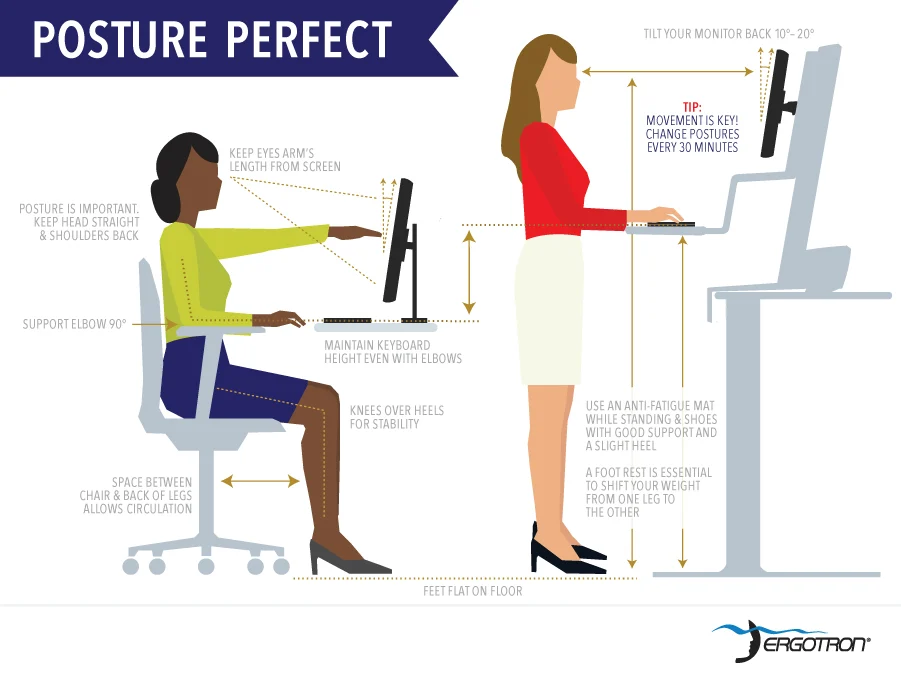
- Your feet should be flat on the floor or on a footrest (textbooks are a good substitute). Adjust your chair so you have about a 90-degree angle at your ankles, knees and hips.
- Sit with your hips all the way back in the chair and your spine upright and long.
- Check how much padding and lumbar support your chair gives you. Not everyone is comfortable with a lot of back support. You should be able to sit back against the support with your back muscles relaxed. If you can’t, try a chair with a different amount of lumbar support.
- Set your desk height so your elbows are at about 90 degrees and your wrists are level with, or slightly lower than, your elbows.
- Keep your elbows close to your sides and keep things you use often within easy reach, so you don’t overreach during the day.
- Be mindful of your typing style. Let your hands float across the keyboard and only rest your wrists between typing, rather than pivoting from your wrists while you type.
- Make sure your keyboard isn’t tilted up, so your wrists aren’t held bent back as you type.
- Adjust your monitor height so your eyes are level with the top third of the screen.
- Place your monitor about an arm’s length away when you are sitting at your desk.
- If you use more than one screen, position them so you aren’t turning your neck a lot, for long periods or over and over during the day.
How is your posture?
Your posture changes a lot through the day and over your life. Posture problems can arise when your centre of mass isn’t lined up over your base of support (your feet). This can put extra strain on muscles, joints, ligaments and nerves, especially if you often sit or stand in the same position for long periods.
In the pictures below we used a plumb line as a reference for the midline.
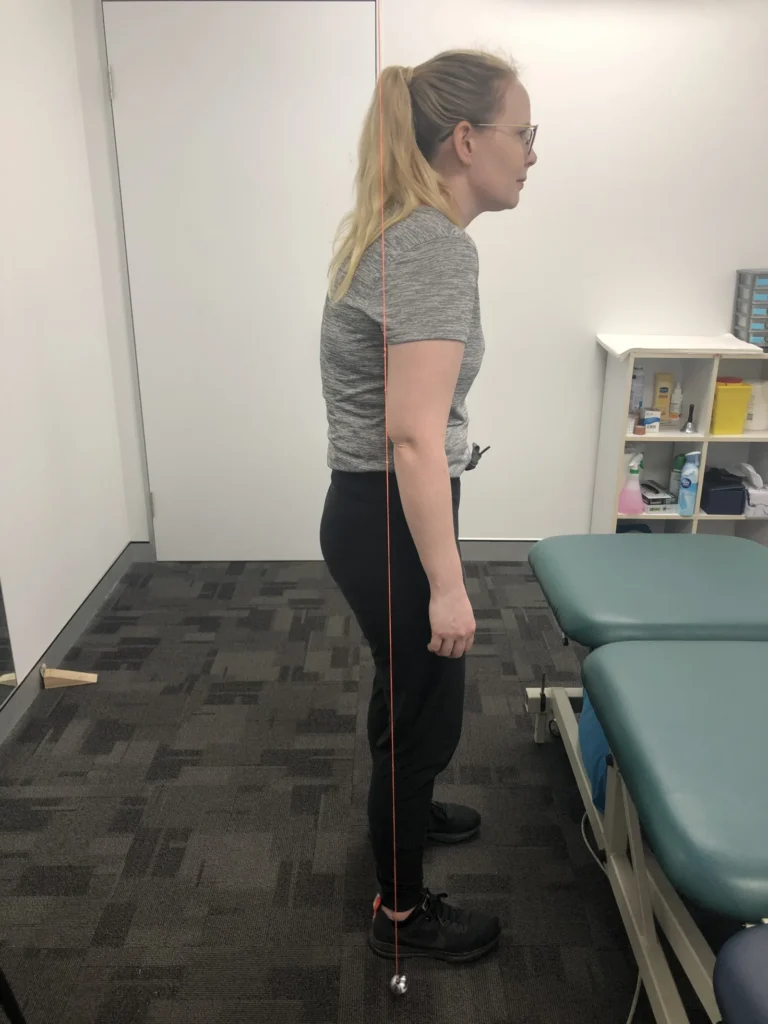
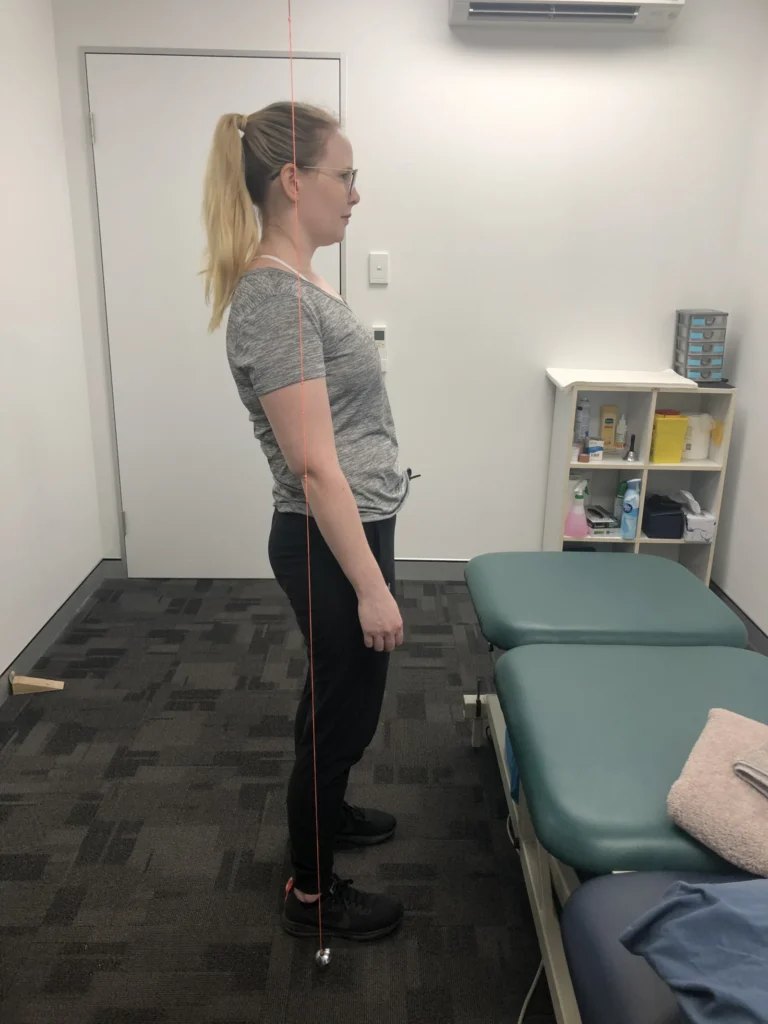
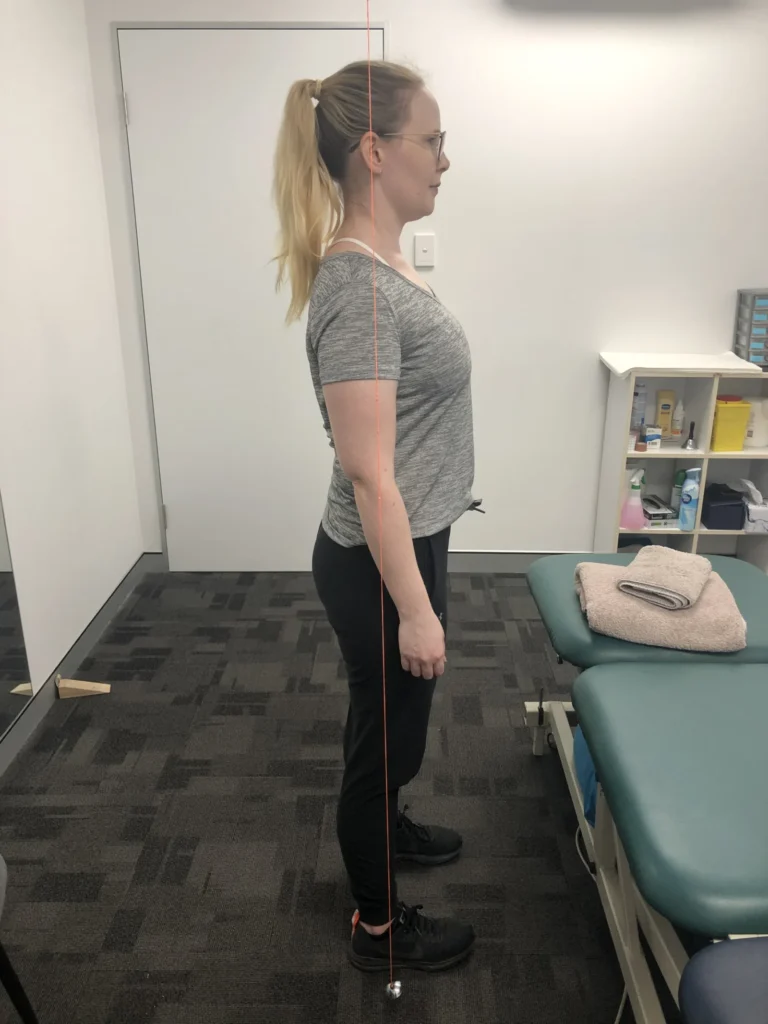
Standing side-on to a plumb line, the line should ideally pass:
- Just in front of the outer ankle bone
- Slightly in front of the middle of the knee
- Through the bony point at the top of the thigh (greater trochanter)
- Through the middle of the trunk
- Through the middle of the shoulder
- Through the earlobe
Sway back posture (first picture)
The hips sit too far forward, the pelvis tips forward, the low back hinges and the trunk leans back. This posture commonly leads to low back pain, and hip pain is also common. Core and hip control exercises are generally used to help.
Forward head posture (second picture)
The trunk leans forward, the shoulder blades round and the head pokes forward. This can lead to upper back and neck pain, and headaches are also common. Upper back and neck strengthening and upper back mobility exercises are generally used to help.
Neutral posture (third picture)
The plumb line passes through all the points above and the spine is long. Whole-body strength and mobility exercises help you keep it that way.
Three simple stretches you can do at your desk
Our bodies are designed to move, and long periods of sitting often lead to tight muscles and stiff joints. Try these stretches in your chair during the day.
Trunk rotation
- Keep your feet on the ground and your weight even through both sides of your bottom.
- Twist your upper body to one side. Feel the twist through your spine, not just your shoulders.
- For a stronger stretch, hold the back of the chair with the hand on the side you are turning towards.
- Hold for 30 seconds, then repeat on the other side.
- This is a good stretch if your mid back feels stiff.
Knee to chest stretch
- Move your chair out from your desk so you have room to lift your knee.
- Hug both hands around the back of one thigh and gently pull it towards your chest.
- Hold for 30 seconds. You may feel a stretch in your bottom.
- Repeat on the other side.
- This is a good stretch if your buttock or low back feels tight.
Side bend neck stretch
- Place your right hand under the right side of your bottom and relax your shoulders.
- Tilt your head to the left, bringing your left ear towards your left shoulder.
- Feel a stretch along the right side of your neck. Hold for 30 seconds.
- Repeat on the other side.
- This is a good stretch if the back and sides of your neck feel tight.
When to get help
These tips are general pointers. If you often have pain at work or by the end of your workday, talk with your physiotherapist. We can give you advice that suits you, look at the underlying cause of your symptoms and build a management plan with you. Taking a photo of yourself at your workstation is a great way to show your physio exactly how you sit or stand, and a telehealth appointment lets us look at your set-up at home.
*All information is general in nature and is not intended to be a substitute for professional medical advice. Physionorth can consult with you to confirm if this advice is right for you.