
Tennis elbow
Pain on the outside of your elbow when you grip, lift a kettle or use a mouse? Tennis elbow is a common tendon problem that usually responds to the right loading plan, and you don't need a referral.
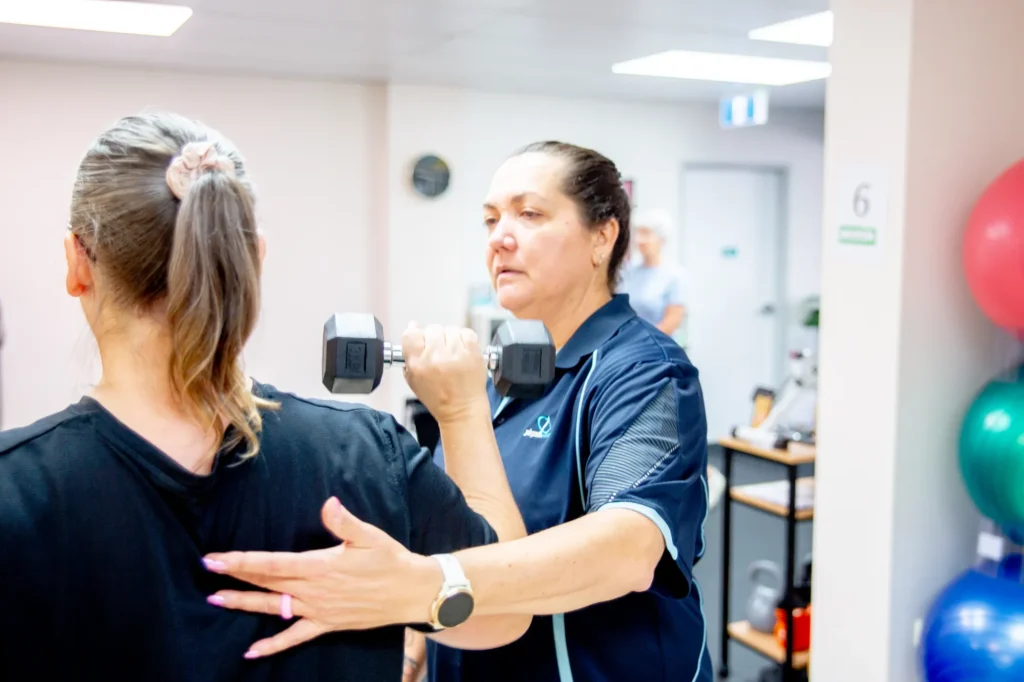
About tennis elbow
Tennis elbow, also called lateral elbow pain, is pain and tenderness on the bony bump on the outside of the elbow, where the forearm muscles that lift your wrist attach. It hurts most when you grip, twist or lift with your palm facing down. Despite the name, most people who get it don't play tennis.
It is a tendon problem that usually builds up when you do more gripping or wrist work than the tendon is used to: tool work, gardening, renovating, long hours on a keyboard and mouse, or racquet sports. Healthdirect notes it affects about 2 in 100 people aged 30 to 65, and that recovery can be slow, taking 6 to 12 months for some people.
Golfer's elbow is the same kind of problem on the inside of the elbow, affecting the muscles that bend the wrist and grip. It is treated in a similar way. Pain from the neck can also be felt around the elbow, so we check that too.

Change how you grip, not everything you do
Complete rest rarely helps a tendon, but easing the load does. Lift with your palm facing up, use both hands, take short breaks from the mouse or tools, and try a thicker grip on tools and racquets. A forearm strap just below the elbow helps some people with grip pain.
Slow, controlled wrist exercises, done regularly, are a key part of recovery. Some discomfort while you exercise is usually okay if it settles within a day.
How we treat it
We ask about your work, hobbies and sport, test your grip strength and the tendon, and check your neck, shoulder and wrist. We also look at the tasks and tools that load your elbow during the day, because changing these is often as important as the exercises.
Treatment may include:
- a progressive tendon-loading program for the wrist and forearm muscles
- hands-on treatment such as soft tissue release and joint mobilisation
- dry needling or taping for short-term pain relief
- advice on your workstation, tools and technique
- shoulder and upper back strengthening, so the elbow isn't doing all the work
Remedial massage can sit alongside your exercise program. If pain persists after a good trial of exercise, we will talk with your GP about other options.
Read more on our blog: 6 things you need to know about tendinopathy and Pros and cons of cortisone injections.
your elbow is hot, red and swollen and you feel unwell or have a fever, you have numbness, pins and needles or weakness in your hand, or the pain started after a fall and the elbow is swollen, looks out of shape or won't straighten. Also see a doctor if the pain is constant, wakes you at night and no position eases it.
Getting started
Who you'll see
One of our physiotherapists, one to one in a private room. You can choose your physiotherapist when you book. Meet the team.
Your first appointment
60 minutes. We listen to your story, check how you move, explain what we find and start treatment, then give you a short plan to follow at home. Follow-up appointments are 30 minutes.
Cost and rebates
First appointment $225. Follow-up $150, or $135 on a pass. No referral needed. We claim private health rebates on the spot with Tyro (works like HICAPS) where available. We are not a bulk billing clinic: with a GP care plan (GPCCMP), you pay in full and Medicare pays $63.40 back for up to five allied health visits a year. If you can't make an appointment, please give us 24 hours notice. Funding and referrals.
Where and when
Suite 2, 69 Eyre Street, North Ward, Townsville. Free parking on both sides of Eyre Street, plus an accessible bay right outside. Open Monday to Thursday 7 am to 7 pm, Friday 7 am to 3:30 pm and Saturday 7 am to 1:30 pm. Book online or call 07 4724 0768.
Common questions
Should I get a cortisone injection?
It may ease pain for a few weeks, but studies suggest it can be linked with a higher chance of the pain coming back later. Talk it over with your GP, and read our blog on the pros and cons of cortisone injections.
Do I need a brace?
Not everyone does. A forearm strap can ease pain during gripping tasks for some people. It is used alongside exercise, not instead of it.
How long does tennis elbow last?
Recovery varies and can be slow. Some people take 6 to 12 months. Steady exercise and sensible changes to your daily load give the tendon a good chance to recover.
Can I keep working or playing?
Usually yes, with changes. Your physio will help you adjust your tasks, technique or training so you can keep going while the tendon settles.
Do I need a referral?
No. Private patients can book straight in. If you have a GP care plan from your GP, you can claim a Medicare rebate.